
Our science
Two mechanisms, delivered where the tumor is.
Getting past the blood-brain barrier
The blood-brain barrier protects the brain from toxins, but it also keeps out most medicines. Drugs given by mouth or by injection travel through the bloodstream, and only a small fraction reaches brain tissue. Raising the dose to compensate often brings side effects elsewhere in the body.
The upper nasal cavity offers another way in. Nerve pathways that connect the nose to the brain, the olfactory and trigeminal routes, can carry suitable molecules directly into brain tissue and the fluid around it. LMP01 is an intranasal formulation designed to use this route.
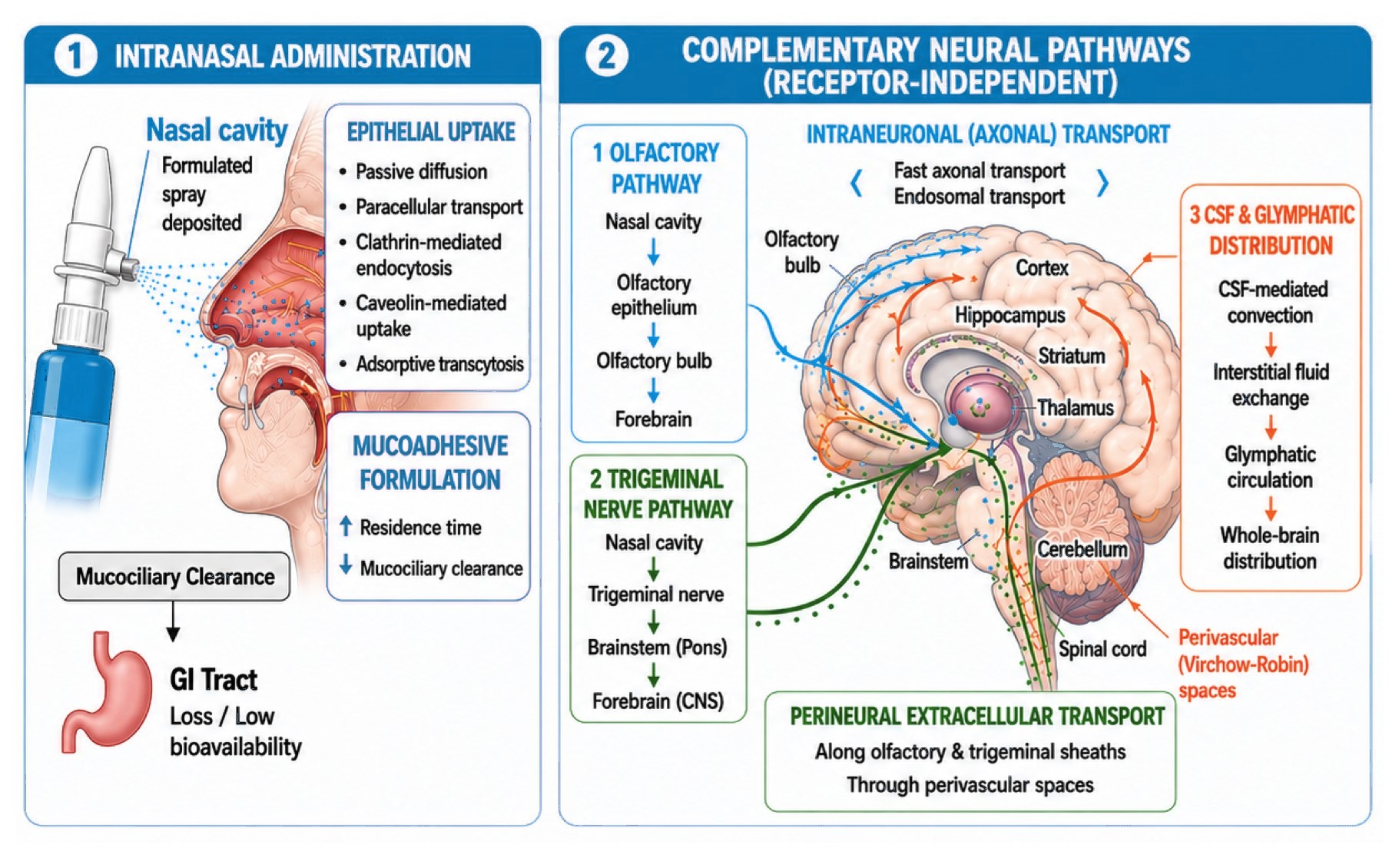
From the nose to the tumor
Reaching the brain is the first step. The components then need to reach the tumor and the infiltrating cells around it at concentrations high enough to act. Our current studies measure how much of each component reaches the brain. They also measure how much ends up in the lungs and gut, where a small share of any intranasal dose is expected to go. These data will tell us how closely the model above matches what happens in practice.
Two pathways, one combination
Glioblastoma cells rewire their metabolism to rely on aerobic glycolysis, a fast but inefficient way of producing energy that also supplies the building blocks for new cells. At the same time, RAS and cell-cycle signaling push the cells to keep dividing.
LMP01 combines two small molecules, each acting on one of these pathways. Tumors are adaptable, and a cell that finds a way around one pressure point can still be held back by the other. Our cell-based studies show synergy between the two components, and our in vivo and proteomic work is helping us understand how the combination acts.
Built on existing molecules
Both LMP01 components are existing compounds with a substantial body of published preclinical and clinical research. Building on that knowledge lets us focus our work on what is new: the combination, the dose and the route of delivery.
Our current studies are designed to test efficacy in glioblastoma models and to measure where each component goes in the body. Read about LMP01’s development status.